Does Evolution Run Faster When Life Is Simple?
A novel idea on the rapid surge of life on Earth...

One of the enduring puzzles in biology is how quickly life appears in Earth’s early history. Geological evidence suggests that once the planet cooled enough to sustain liquid water, signs of biological activity emerged surprisingly soon. This has led to a natural question: How did evolution proceed from simple chemistry to functional cells in such a short window of time?
A useful way to approach this is to consider whether evolution might actually proceed faster when systems are very simple. This isn’t a claim about certainty, more a conceptual framework that may help explain the rapid early steps in life’s history.
1. A Puzzle Analogy: Why Small Systems Change More Dramatically
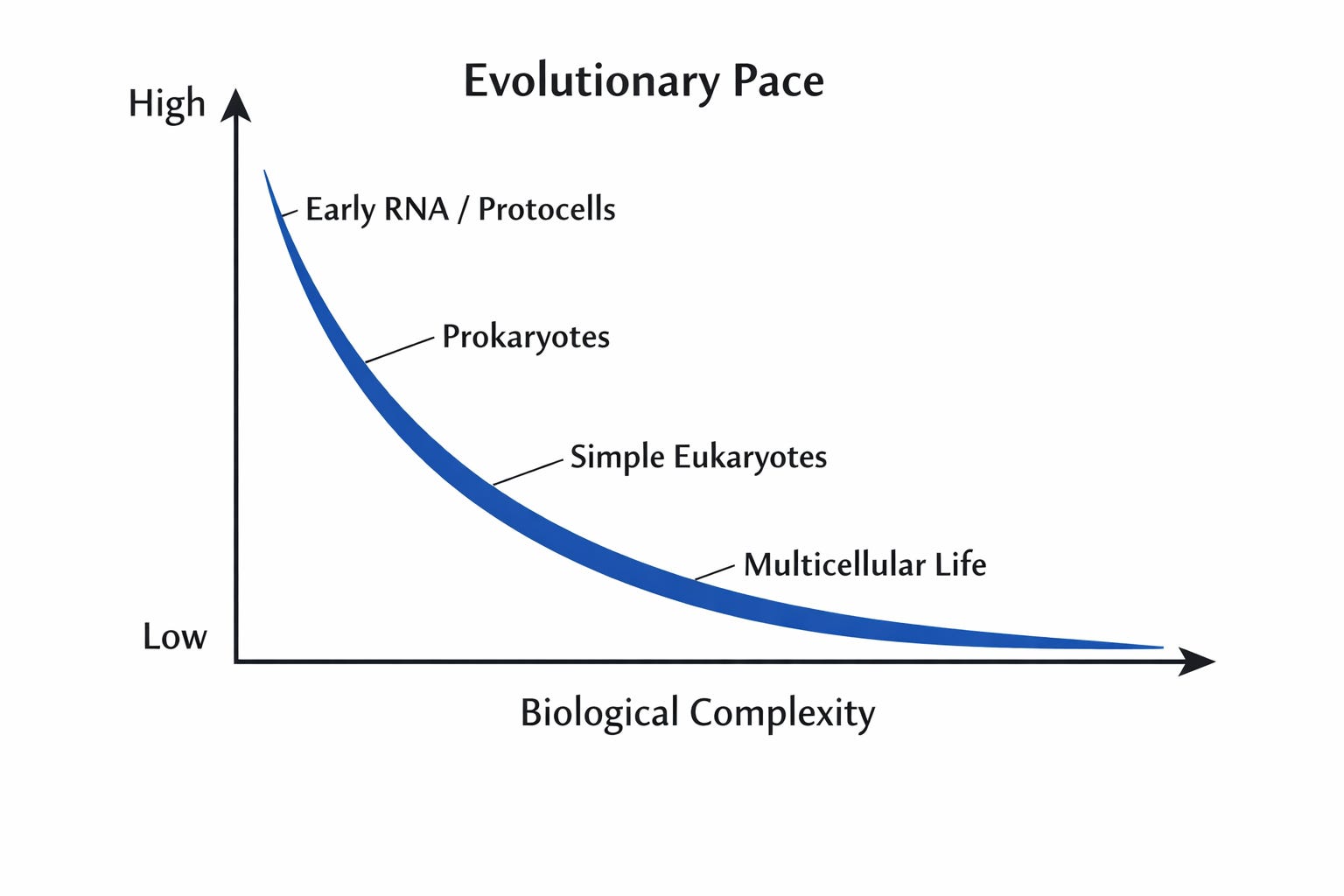
Imagine two jigsaw puzzles: one has 12 pieces, the other has 12 million pieces. If you swap two pieces in the 12‑piece puzzle, the entire image changes. If you swap two pieces in the 12‑million‑piece puzzle, the overall picture barely shifts. This captures a basic evolutionary principle: in small, simple systems, a single change can have a large effect; in large, complex systems, a single change is diluted by the surrounding structure. Early life, perhaps short RNA molecules or protocells, was the 12‑piece puzzle. Modern organisms, flies, humans, are the 12‑million‑piece puzzle. This difference in mutational leverage may be central to understanding early evolutionary speed?
2. Orders of Magnitude: How Complexity Scales
To make this more concrete, consider three systems:
Early RNA replicator
A minimal catalytic RNA might be ~100 nucleotides long
Information content: ~200 bits
Components: one molecule
Regulation: none
Baseline complexity: 1
Fruit fly (Drosophila)
Genome: ~1.4 × 10⁸ base pairs
Information: ~2.8 × 10⁸ bits
Cells: ~10⁷–10⁸
Complexity: ~10⁶–10⁸× higher than early RNA
Human
Genome: ~3.2 × 10⁹ base pairs
Information: ~6.4 × 10⁹ bits
Cells: ~3 × 10¹³
Complexity: only ~10× more genomic information than a fly, but far more cells
The jump from RNA → fly is enormous, millions of times more information and many orders of magnitude more structure. The jump from fly → human is comparatively modest. This suggests that the earliest stages of evolution may have been the most transformative.
3. Why Early Evolution Could Have Been Extremely Fast
Several factors naturally accelerate evolution in simple systems:
High mutation rates: early RNA replication was error‑prone, far more so than modern DNA replication
Few moving parts: fewer interactions, fewer constraints, fewer ways to break
Minimal regulation: early replicators had none, changes propagated immediately
Rapid turnover: replication cycles were short
RNA’s flexibility: folding, catalysis, binding, self‑assembly
Together, these factors create an environment where evolution can proceed at a pace that looks almost explosive compared to modern biology.
4. A Simple Evolutionary Scaling Idea
A rough way to express this is:
Evolutionary Speed ∼ Mutation Rate × Effect Size / System Complexity
Early life: high mutation rate, large effect size, tiny complexity → fast evolution
Modern life: low mutation rate, small effect size, huge complexity → slow evolution
This framework helps explain why the deepest innovations; replication, translation, membranes, metabolism appear early.
5. Why This Idea Matters
The origin of life may not require vast timescales. The transition from chemistry to biology could occur relatively quickly once the right conditions exist. This helps resolve the long‑standing “not enough time” problem in early Earth history.
Simple life may be common in the universe. If early evolution is fast and robust, then protocells, ribozymes, and simple replicators might arise readily on planets with suitable chemistry.
Complex life could remain rare? Fast early evolution does not imply fast later evolution. Once systems become large and regulated, evolutionary change slows dramatically. This could explain why microbial life might be widespread while complex multicellular life remains exceptional.
This might reframe the search for life also. We may expect very many worlds with simple replicators, fewer with stable, long‑term evolutionary trajectories, and very few with complex organisms. This aligns with the idea that the universe may be full of “12‑piece puzzles,” but only rarely produces the “12‑million‑piece” ones.